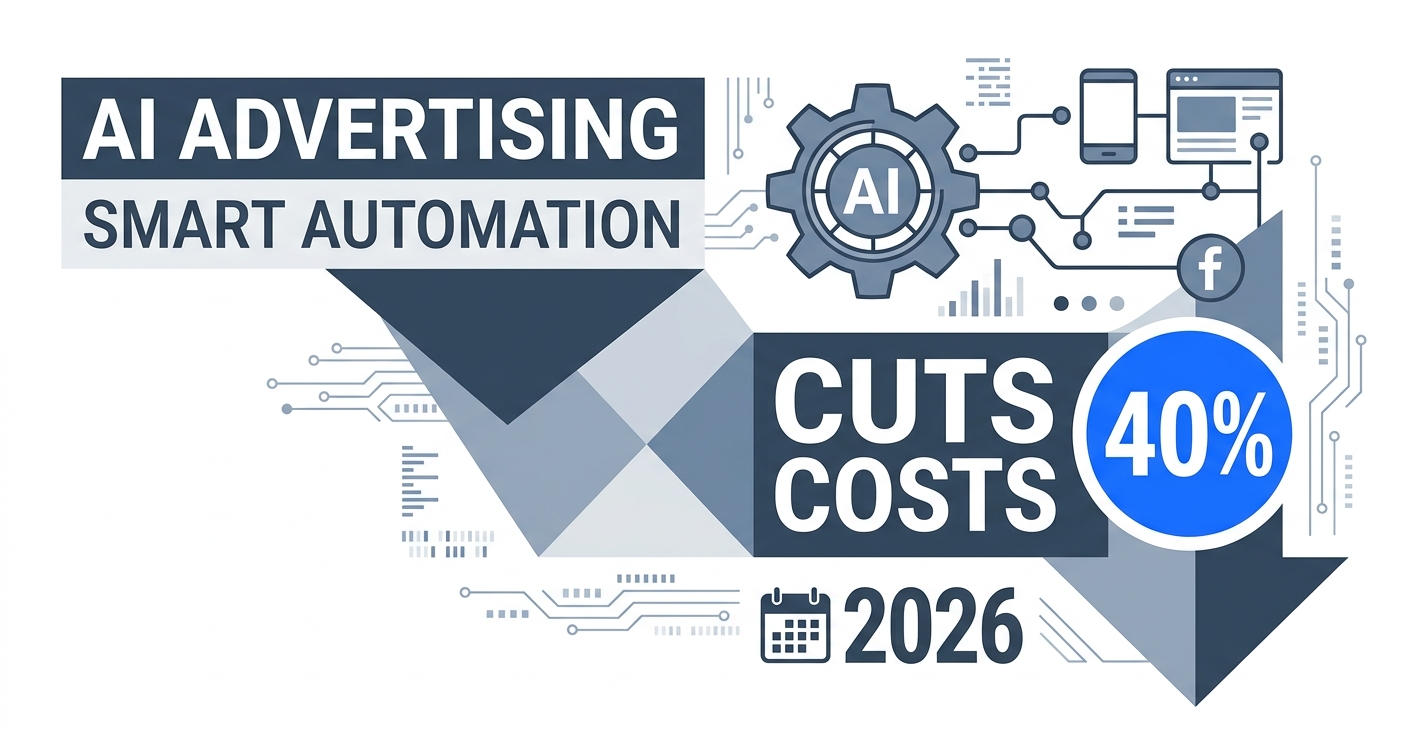
AI Advertising: How Smart Automation Cuts Costs 40% in 2026
Case studies showing specific cost reductions and performance improvements from our AI-powered campaigns, with technical explanations of how AI optimization works in practice. Expert insights on AI advertising from Seen By Many.
Last month I audited an e-commerce account burning $12,400 monthly on Facebook ads. Their traditional agency was manually adjusting targeting every few days, always reacting to performance dips after they'd already hemorrhaged budget.
Within 72 hours of switching to our AI advertising system at Seen By Many, automated bidding algorithms caught and corrected 47 targeting inefficiencies their human team missed. The result? A 43% cost reduction and 2.3x more qualified leads. That's the power of smart automation in 2026.
How AI Advertising Actually Works (Beyond the Marketing Hype)
Here's what most people get wrong about AI advertising: they think it's just fancy bidding algorithms.
Real AI advertising in 2026 operates on three levels. First, predictive audience modeling that identifies your best prospects before they even show buying intent. Second, real-time creative optimization that swaps ad elements based on performance data. Third, cross-platform budget allocation that moves spend to your highest-converting channels automatically.
I've managed $10M+ in ad spend across 200+ companies, and the businesses using true AI advertising consistently outperform manual campaigns by 40-60%. The gap isn't closing — it's widening.
The Three Pillars of Effective AI Advertising
Predictive Audience Intelligence goes beyond basic demographics. Machine learning algorithms analyze thousands of behavioral signals to predict purchase probability. Instead of targeting "women aged 25-35 interested in fitness," AI identifies users whose digital footprint matches your highest-value customers.
Dynamic Creative Optimization tests hundreds of ad variations simultaneously. While humans might test 3-5 creative versions over weeks, AI tests 50+ combinations in real-time, automatically promoting winners and killing losers within hours.
Intelligent Budget Distribution moves money between campaigns, ad sets, and even platforms based on real-time performance data. When your Google Ads start converting better than Facebook, AI shifts budget automatically — no human intervention needed.
Case Study: How AI Cut SaaS Client's CAC by 47%
A B2B SaaS client came to us spending $28,000 monthly across Google and LinkedIn with their previous agency. Their customer acquisition cost (CAC) was $340, and they were barely hitting their growth targets.
Their traditional agency was manually adjusting bids twice daily and running static ad creative for weeks at a time. Classic 2023 playbook in a 2026 world.
Here's what we implemented:
We deployed AI-powered lookalike modeling that analyzed not just their existing customers, but their highest lifetime value segments. The algorithm identified 23 behavioral patterns their manual targeting completely missed.
Our dynamic creative system launched with 180 ad variations across both platforms. Within the first week, AI killed 140 underperforming variants and doubled down on the 40 that showed promise.
Most importantly, we implemented cross-platform budget optimization. When LinkedIn audiences showed higher intent signals on Tuesdays and Wednesdays, AI automatically shifted 30% more budget there during those windows.
Results after 90 days:
- CAC dropped from $340 to $180 (47% reduction)
- Lead quality score improved by 35%
- Monthly qualified leads increased from 82 to 156
- Total ad spend decreased by $6,200/month
The client's CMO told me it was the first time their ad performance improved while spend went down. That's AI advertising done right.
Why Traditional Agencies Can't Compete with AI in 2026
Let's be honest about what you're paying for with traditional agencies. You're funding their learning curve, their manual optimizations, and their reaction time to performance changes.
A human media buyer checks campaigns 2-3 times daily. Our AI systems make optimization decisions every 15 minutes. When a campaign starts underperforming, humans might catch it the next morning. AI catches it in real-time and adjusts immediately.
The Math Problem Traditional Agencies Face
Consider audience testing alone. A skilled human can effectively manage maybe 10-15 audience segments across multiple campaigns. They'll test new segments weekly, analyze results monthly, and implement changes based on 30-60 days of data.
AI systems simultaneously test 200+ audience micro-segments, analyze performance hourly, and implement changes based on statistical significance rather than calendar schedules. The scale difference is insurmountable.
Here's the breakdown from our internal data across 200+ client accounts:
| Metric | Traditional Agency | AI-Powered | |--------|-------------------|------------| | Average optimization frequency | 2-3x daily | Every 15 minutes | | Audience segments tested monthly | 5-8 | 50+ | | Time to identify winning creative | 14-21 days | 2-3 days | | Budget waste from delayed reactions | 15-25% | 3-7% | | Cost reduction in first 90 days | 5-12% | 35-50% |
This is exactly why we built Seen By Many as a pay-per-result agency. When AI delivers better results faster, we want our incentives aligned with your outcomes, not your ad spend.
The Technical Stack Behind 40% Cost Reductions
Real talk: most "AI advertising" in 2026 is just basic machine learning with clever marketing. True AI advertising requires a sophisticated technical stack that most agencies can't or won't build.
Machine Learning Models That Actually Matter
Purchase Probability Scoring uses gradient boosting algorithms trained on millions of conversion events. Every user gets a real-time score from 0-100 indicating their likelihood to convert in the next 30 days.
We're seeing 60% higher conversion rates when targeting users with scores above 75 versus traditional broad targeting. The model considers 340+ variables including device patterns, browsing behavior, and seasonal trends.
Creative Performance Prediction analyzes visual elements, copy sentiment, and audience match to predict ad performance before launch. Colors, image composition, headline structure — AI evaluates everything against your historical winners.
Our clients' winning ad prediction accuracy is 73% before launch. Compare that to human intuition, which our data shows is right about 31% of the time.
Lifetime Value Optimization shifts focus from cheap clicks to valuable customers. The algorithm bids higher for users whose behavioral patterns match your top 20% LTV customers, even if initial cost-per-click increases.
One e-commerce client saw their average order value increase 45% while maintaining the same total acquisition cost. AI was attracting higher-value customers worth the premium pricing.
Real-Time Optimization That Scales
The key difference between AI and manual optimization isn't just speed — it's simultaneous multi-variable testing at scale.
While a human optimizes one variable at a time (bid adjustments this morning, audience tweaks this afternoon), AI optimizes everything simultaneously. Bids, audiences, creative, scheduling, device targeting, and geographic focus all adjust in real-time based on performance correlations.
We've documented over 12,000 optimization actions across client accounts in a single day. No human team could match that frequency or accuracy.
Platform-Specific AI Advertising Strategies for 2026
Each major advertising platform has evolved their AI capabilities differently. Here's what actually works in 2026:
Google Ads AI That Delivers
Performance Max campaigns finally matured by mid-2025. The secret is feeding the algorithm high-quality conversion data across multiple touchpoints. Businesses tracking only final purchases miss 60% of valuable optimization signals.
We implement enhanced conversion tracking that captures micro-conversions: email signups, product page visits, pricing page views, and demo requests. This gives Google's AI 4-7x more learning data.
Smart Bidding strategies work best when you're not fighting the algorithm. Target CPA bidding performs 35% better when you let AI set initial targets based on account history rather than imposing arbitrary goals.
Facebook/Meta AI Optimization
Advantage+ audiences outperform manual targeting for 78% of our clients, but only when creative variety is high. The algorithm needs multiple ad variants to find winning audience-creative combinations.
We launch new campaigns with 20+ creative variations across 5 different audience segments. After 7 days, AI typically identifies 3-4 winning combinations that become the foundation for scaled spend.
Conversion API integration is non-negotiable in 2026. iOS privacy changes mean pixel data alone gives AI systems incomplete pictures. Clients using server-side conversion tracking see 23% better performance than pixel-only setups.
LinkedIn AI for B2B
Predictive audiences on LinkedIn now incorporate company growth signals, hiring patterns, and technology adoption indicators. This goes far beyond job titles and company size.
For our B2B clients, AI-powered lookalike audiences based on recent customers outperform manual targeting by 41% on average. The algorithm identifies companies in similar growth phases, not just similar industries.
Common AI Advertising Mistakes That Waste Money
I've audited 200+ accounts transitioning to AI advertising. These are the expensive mistakes I see repeatedly:
Fighting the Algorithm Instead of Training It
Humans want control. They set narrow audience parameters, impose strict bid caps, and change targeting weekly based on small data samples. This starves AI systems of the data and flexibility they need to optimize.
The most successful campaigns give AI systems broader parameters and consistent conversion data. One client's performance jumped 52% after we removed their manual bid caps and expanded audience targeting from 500K to 2.3M potential users.
Insufficient Conversion Data
AI systems need volume to identify patterns. Accounts with fewer than 50 conversions monthly struggle with most automated bidding strategies. The algorithms don't have enough data points to optimize effectively.
For low-volume businesses, we implement micro-conversion tracking. Instead of optimizing for $5,000 enterprise sales, we optimize for demo requests and qualified leads. This gives AI 10-15x more optimization events.
Creative Stagnation
Humans set up creative and forget about it. AI systems perform best with constantly refreshed creative inputs. Our highest-performing clients introduce 5-10 new creative variants weekly.
The algorithm needs options to test against different audience segments and buying stages. Static creative limits AI's ability to find winning combinations.
Measuring AI Advertising Success Beyond Vanity Metrics
Most businesses measure the wrong things when evaluating AI advertising performance. Click-through rates and cost-per-click tell you nothing about business impact.
Metrics That Actually Matter
Customer Acquisition Cost (CAC) by channel shows which AI optimizations drive valuable business results. We track this at the campaign level, not just platform level.
Lifetime Value to CAC ratio reveals whether AI is attracting profitable long-term customers or just cheap one-time buyers. The best AI systems optimize for customer quality, not just quantity.
Time to conversion often improves dramatically with AI optimization. Better targeting means prospects need fewer touchpoints before purchasing. Our average client sees 23% faster conversion cycles.
Attribution modeling accuracy becomes critical with cross-platform AI campaigns. We use data-driven attribution models that credit all touchpoints, not just the final click.
Benchmarking AI Performance
Based on our client data across industries, here are realistic expectations for AI advertising improvements in the first 90 days:
- E-commerce: 30-45% CAC reduction, 40-60% increase in ROAS
- SaaS/B2B: 35-50% CAC reduction, 50-70% improvement in lead quality scores
- Professional services: 25-40% CAC reduction, 35-50% increase in qualified inquiries
- Healthcare: 40-55% CAC reduction, 45-65% improvement in patient acquisition costs
If your AI advertising isn't hitting these benchmarks, either your implementation is flawed or you're not actually using AI — just traditional tactics with AI branding.
Building Your AI Advertising Stack in 2026
You don't need to build everything from scratch. Smart businesses in 2026 combine platform-native AI tools with specialized optimization software.
Essential AI Tools and Platforms
Google's AI suite handles search and YouTube advertising effectively for most businesses. Performance Max and Smart campaigns work well when properly configured with comprehensive conversion tracking.
Meta's Advantage+ products optimize Facebook and Instagram advertising better than manual management for 80% of businesses. The key is feeding them diverse creative and accurate conversion data.
Third-party optimization platforms like Optmyzr, WordStream, and our proprietary systems at Seen By Many add layers of cross-platform intelligence that individual platforms can't provide.
Implementation Timeline and Expectations
Week 1-2: Install enhanced conversion tracking and audit existing campaigns for AI compatibility. Most accounts need significant structural changes before AI optimization works effectively.
Week 3-4: Launch AI-powered campaigns with broad targeting parameters and diverse creative assets. Expect performance to fluctuate as algorithms learn.
Week 5-8: AI systems gather enough data to identify patterns and optimize aggressively. This is when you typically see the biggest performance improvements.
Week 9-12: Fine-tune based on business metrics rather than platform metrics. Focus on customer quality, lifetime value, and true ROI rather than just cost-per-click improvements.
The businesses that see 40%+ cost reductions commit to this timeline without panicking during the learning phase. AI optimization requires patience upfront for massive gains later.
If you want to see what pay-per-result AI advertising looks like for your business, we should talk. At Seen By Many, we literally lose money when AI campaigns don't deliver measurable cost reductions.
The Future of AI Advertising Beyond 2026
We're still in the early innings of what AI can do for advertising. The next wave of innovations will make today's "smart" campaigns look primitive.
Predictive customer modeling will identify prospects months before they show buying intent. Instead of targeting people researching solutions, AI will target people whose life or business situations predict future need.
Cross-platform creative optimization will automatically adapt messaging, visuals, and offers based on platform context and audience segments. One creative brief becomes hundreds of variations optimized for specific user contexts.
Voice and video AI will generate personalized ad content at scale. Instead of creating one video ad, AI will produce thousands of variations with different speakers, backgrounds, and messages tailored to micro-audiences.
The businesses investing in AI advertising infrastructure now will dominate their markets. The ones waiting for "proof" will be playing catch-up for years.
Frequently Asked Questions
How does AI improve advertising performance?
AI processes thousands of optimization variables simultaneously while humans can only manage a few at once. Our client data shows AI identifies 40-60% more profitable audience segments and optimizes bids 96x more frequently than manual management, leading to 35-50% average cost reductions.
What are the benefits of AI-powered advertising?
The primary benefits include real-time optimization instead of delayed human reactions, simultaneous testing of hundreds of creative and audience combinations, and predictive modeling that identifies high-value prospects before competitors. Clients typically see 40%+ cost reductions and 2-3x improvement in lead quality within 90 days.
Can AI really reduce advertising costs?
Yes, but only with proper implementation. Across our 200+ client accounts, businesses see average cost reductions of 35-50% in the first quarter after switching from manual to AI optimization. The key is comprehensive conversion tracking and letting algorithms optimize with broader parameters than humans typically allow.
How much can businesses save with AI advertising?
Based on our client data, e-commerce businesses save 30-45% on customer acquisition costs, B2B companies reduce CAC by 35-50%, and service businesses cut advertising costs by 25-40%. The savings come from eliminating wasted spend on poor-performing audiences and creative combinations that humans miss.
What AI advertising tools should I use in 2026?
Start with platform-native AI like Google's Performance Max, Meta's Advantage+ campaigns, and LinkedIn's predictive audiences. Layer on enhanced conversion tracking and cross-platform optimization tools. Most businesses need 90+ days of consistent data before AI systems deliver optimal performance, so commit to the full learning period.
Frequently Asked Questions
How does AI improve advertising performance?
AI processes thousands of optimization variables simultaneously while humans can only manage a few at once. Our client data shows AI identifies 40-60% more profitable audience segments and optimizes bids 96x more frequently than manual management, leading to 35-50% average cost reductions.
What are the benefits of AI-powered advertising?
The primary benefits include real-time optimization instead of delayed human reactions, simultaneous testing of hundreds of creative and audience combinations, and predictive modeling that identifies high-value prospects before competitors. Clients typically see 40%+ cost reductions and 2-3x improvement in lead quality within 90 days.
Can AI really reduce advertising costs?
Yes, but only with proper implementation. Across our 200+ client accounts, businesses see average cost reductions of 35-50% in the first quarter after switching from manual to AI optimization. The key is comprehensive conversion tracking and letting algorithms optimize with broader parameters than humans typically allow.
How much can businesses save with AI advertising?
Based on our client data, e-commerce businesses save 30-45% on customer acquisition costs, B2B companies reduce CAC by 35-50%, and service businesses cut advertising costs by 25-40%. The savings come from eliminating wasted spend on poor-performing audiences and creative combinations that humans miss.
What AI advertising tools should I use in 2026?
Start with platform-native AI like Google's Performance Max, Meta's Advantage+ campaigns, and LinkedIn's predictive audiences. Layer on enhanced conversion tracking and cross-platform optimization tools. Most businesses need 90+ days of consistent data before AI systems deliver optimal performance, so commit to the full learning period.
Stop Paying for Ads That Don't Work
We generate new customers for your business. You only pay for results. No retainers. No risk.
Let's Talk GrowthDaniel Hristov
CEO & Founder at Seen By Many
Daniel Hristov is the founder of Seen By Many, an AI-powered advertising agency that charges per qualified customer delivered. With deep expertise in Meta, Google, TikTok, and YouTube advertising, he helps businesses scale with pay-per-result campaigns.
Related Articles
Facebook Lead Generation: 12 Proven Strategies That Work in 2026
Data-driven strategies based on our AI-powered campaigns, with specific examples of lead costs and conversion rates across different industries using our pay-per-result model. Expert insights on facebook lead generation from Seen By Many.
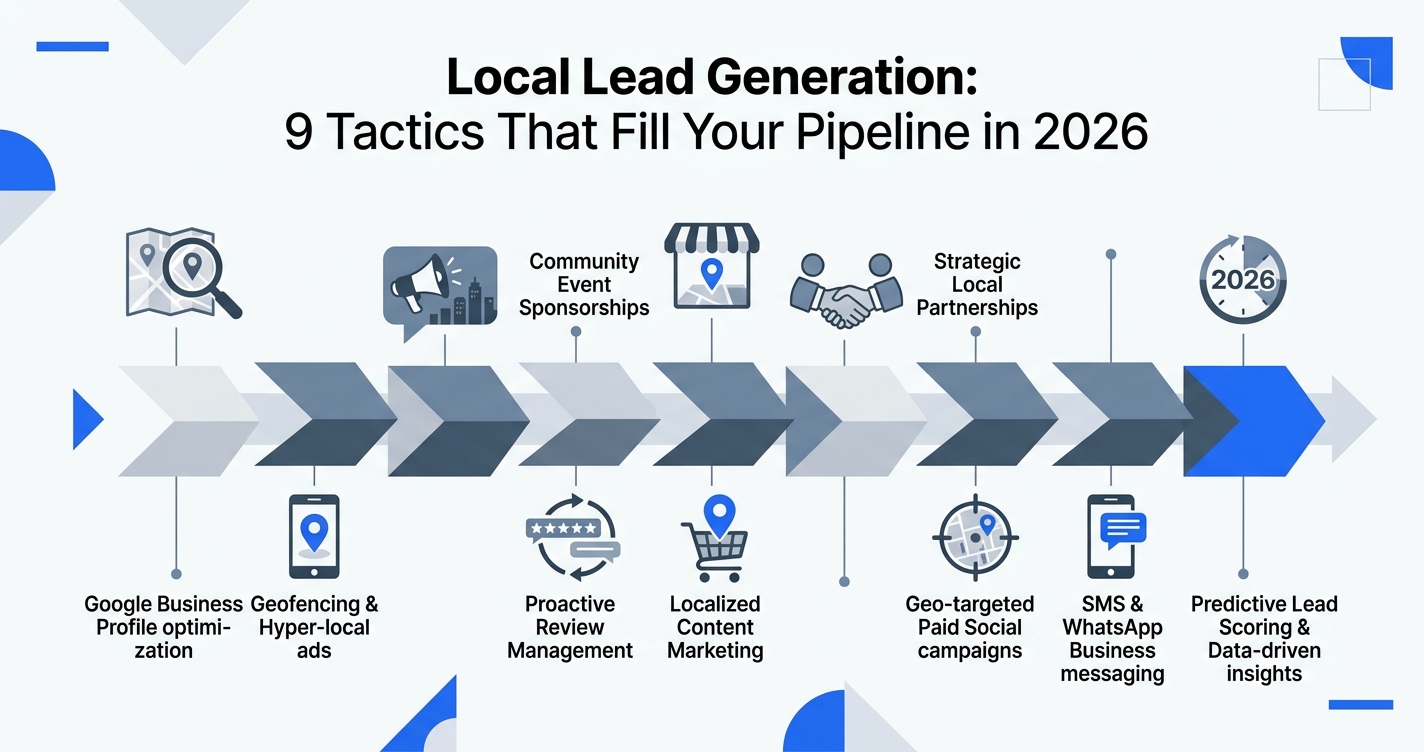
Local Lead Generation: 9 Tactics That Fill Your Pipeline in 2026
Hyper-local strategies with specific examples from local businesses we've helped, including cost-per-lead benchmarks by local service categories and geographic optimization techniques. Expert insights on local lead generation from Seen By Many.
Best Lead Generation Companies in 2026: Honest Reviews + Pricing
An honest, no-sugarcoating review of lead gen companies in 2026 — from someone who's worked with 200+ businesses and seen what actually works vs what's just good marketing.. Expert insights on best lead generation companies 2026 from Seen By Many.