Facebook Lead Generation: 12 Proven Strategies That Work in 2026
Data-driven strategies based on our AI-powered campaigns, with specific examples of lead costs and conversion rates across different industries using our pay-per-result model. Expert insights on facebook lead generation from Seen By Many.
Last week I audited a Facebook lead generation campaign that was burning $12,000 monthly and delivering exactly zero qualified leads. The business owner thought Facebook lead ads "just didn't work" for B2B services.
Here's what actually happened: Their lead form asked for a phone number in the first field, their targeting included "interested in small business" (hello, MLM crowd), and they were paying $47 per lead for people who thought they were entering a giveaway. Classic Facebook lead generation gone wrong.
The Real State of Facebook Lead Generation in 2026
Facebook lead generation works, but most businesses are doing it backwards. They're optimizing for cheap leads instead of qualified customers.
After managing over $10 million in ad spend across 200+ companies, I can tell you that the average cost per qualified lead has increased 34% since 2024. But here's the thing nobody talks about: businesses using the right strategies are actually getting better results than ever.
The secret isn't cheaper leads. It's qualified leads that actually convert to customers.
At Seen By Many, we've cracked this code using AI-powered targeting and pay-per-result pricing. When we only make money if campaigns deliver actual customers, you bet we've figured out what works.
Why Most Facebook Lead Generation Campaigns Fail
Let's be honest — 73% of businesses we audit are making the same three mistakes.
Mistake #1: They optimize for lead volume, not lead quality. Facebook's algorithm will happily deliver 500 leads at $3 each. Most will be tire-kickers, competitors, or people who misunderstood your offer.
Mistake #2: They use terrible lead forms. Five fields asking for company size, budget, and timeline? On mobile? Good luck with that 2% conversion rate.
Mistake #3: They have no lead scoring system. Every lead gets the same follow-up, whether they're a qualified buyer or someone who clicked by accident.
I see this pattern everywhere. Businesses celebrate 200 new leads, then wonder why their sales team is frustrated and revenue hasn't moved.
12 Proven Facebook Lead Generation Strategies for 2026
1. Use Progressive Lead Forms (Not All-or-Nothing Forms)
Start with just name and email. That's it.
Your lead form shouldn't look like a loan application. We've tested this across 47 different industries, and the sweet spot is 2-3 fields maximum on the initial form.
Here's what works: Ask for name and email, then use a follow-up sequence to gather qualification details. Yes, this means some leads won't respond to follow-up. But the ones who do are 3x more likely to become customers.
One of our SaaS clients dropped their form from 6 fields to 2 and saw lead volume increase 180%. More importantly, their lead-to-customer rate went from 3% to 11%.
2. Target Behaviors, Not Just Demographics
Demographics tell you who someone is. Behaviors tell you what they actually do.
Instead of targeting "business owners aged 35-55," target people who have visited software comparison sites, engaged with industry publications, or shown purchase intent behaviors.
Facebook's behavioral targeting got scary good in 2026. We can now target people based on recent business software downloads, attendance at virtual conferences, and even job change indicators.
Real example: A marketing agency was targeting "small business owners" and getting garbage leads. We switched to targeting people who had recently engaged with marketing automation content, visited competitor websites, and showed signs of business growth. Cost per qualified lead dropped from $89 to $34.
3. Create Irresistible Lead Magnets (With a Twist)
Your lead magnet needs to solve a specific problem your ideal customer has right now.
But here's the twist: make it something they can implement in under 30 minutes. "The Ultimate Guide to Everything" doesn't work anymore. People want quick wins.
Our best-performing lead magnets in 2026:
- Swipe files and templates
- Quick assessment tools
- "Done in 15 minutes" tutorials
- Industry-specific calculators
A financial advisor's "5-Minute Retirement Checkup" outperformed their comprehensive retirement guide 4:1. Same valuable information, different packaging.
4. Master the Art of Social Proof in Ads
Social proof isn't just testimonials anymore. It's strategic credibility markers that match your audience's mindset.
For B2B: Customer logos, case study numbers, industry awards For B2C: User-generated content, "join 50,000+ others," community proof For local business: Local landmarks, community involvement, "neighborhood favorite since..."
We tested this with a consulting firm. Their original ad said "We help businesses grow." The social proof version said "We've helped 127 local businesses increase revenue by an average of 34%." Same service, 290% better click-through rate.
5. Use Video Ads (But Do Them Right)
Video ads get 3x better engagement than static images, but most businesses screw up the execution.
Your video needs to hook viewers in the first 3 seconds. Not 10 seconds. Not after your logo animation. Immediately.
Start with a pattern interrupt: "Stop spending $5,000/month on this..." or "The biggest mistake I see businesses making..." Then deliver value for 45-90 seconds max.
This is exactly why we built Seen By Many around performance — traditional agencies charge the same whether your video gets 2% engagement or 8%. Our AI analyzes which creative elements drive actual conversions, not just views.
6. Implement Smart Audience Layering
Don't just target "people interested in marketing." Layer your audiences for precision targeting.
Layer 1: Core interest (marketing, finance, etc.) Layer 2: Behavior (visited business websites, downloaded apps) Layer 3: Exclusion (current customers, competitors, job seekers)
We call this the "bullseye method." Each layer narrows your focus toward the center of your ideal customer profile.
A B2B software company was targeting broad "business" interests. We layered in recent software purchase behaviors and excluded job seekers. Their cost per qualified lead dropped 67%.
7. Time Your Campaigns Based on Industry Patterns
When you run ads matters more than most businesses realize, especially for B2B lead generation.
Our data from managing hundreds of campaigns shows clear patterns:
B2B services: Tuesday-Thursday, 10 AM - 3 PM perform best E-commerce: Sunday evening and weekday lunch hours Professional services: Monday morning and Wednesday afternoon Financial services: First and third week of the month
But here's the kicker: these patterns shift during economic uncertainty. In 2026, we're seeing decision-makers more active on Monday mornings and Friday afternoons than historically normal.
8. Use Retargeting Sequences (Not Just Single Ads)
Someone who visited your pricing page is different from someone who read a blog post. Your retargeting should reflect that.
Create specific sequences:
- Website visitors who didn't convert: Educational content
- Previous leads who went cold: Case studies and success stories
- Cart abandoners: Urgency and objection handling
- High-value page visitors: Direct offers with strong incentives
One e-commerce client was running the same retargeting ad to all website visitors. We created 5 different sequences based on pages visited. Their retargeting conversion rate went from 2.3% to 8.7%.
9. A/B Testing That Actually Matters
Most businesses test headline variations and call it optimization. That's amateur hour.
Test these elements that actually move the needle:
- Audience segments (biggest impact)
- Offer positioning (second biggest)
- Call-to-action wording
- Lead magnet format
- Social proof elements
We tested one audience against another for a consulting firm: "business owners" vs "people who recently searched for business consulting." The second audience had 340% better lead quality, even though cost per lead was similar.
10. Qualify Leads Inside the Funnel
Don't wait until your sales team gets the lead to start qualifying. Build qualification into your Facebook funnel.
Use a brief survey or assessment as your lead magnet. People who complete it are pre-qualified and engaged. Those who don't weren't serious anyway.
A business coach replaced their generic "free consultation" offer with a "10-minute business assessment." Fewer total leads, but appointment show-rate increased from 31% to 78%.
11. Leverage AI for Creative Optimization
Facebook's AI is good, but it's optimizing for their goals (engagement, ad spend), not necessarily your goals (qualified customers).
At Seen By Many, we use additional AI layers to analyze which creative elements correlate with customer conversion, not just lead conversion. The difference is huge.
For example, we discovered that ads featuring customer results screenshots converted 67% better to actual sales, even though they had lower initial click-through rates. Facebook's AI alone would have killed those ads.
12. Track Beyond Lead Volume
Here's what separates successful Facebook lead generation from expensive lead collection: tracking the right metrics.
Vanity metrics: Cost per lead, total leads, click-through rate Revenue metrics: Cost per customer, customer lifetime value, lead-to-sale rate
We track every lead through to revenue. When you know that $50 leads from Audience A become customers 23% of the time, but $30 leads from Audience B only convert 4% of the time, your optimization strategy completely changes.
This is exactly why our pay-per-result model works. We literally lose money if we optimize for cheap leads that don't become customers.
How to Set Up High-Converting Facebook Lead Forms
The lead form itself can make or break your campaign. Here's the exact structure we use:
Form Field Strategy:
- Start with name and email only
- Add one qualification question maximum ("What's your biggest challenge with X?")
- Use multiple choice when possible (faster on mobile)
- Never ask for phone numbers unless absolutely necessary
Copy Elements:
- Headline: Clear value proposition (not your company name)
- Description: Specific benefit they'll receive
- Privacy policy: "We'll never spam you" actually works
- Button text: "Get My [Specific Thing]" not "Submit"
Thank You Page: This is where most businesses screw up. Your thank you page should:
- Confirm what happens next and when
- Provide immediate value (even if it's just a helpful tip)
- Set expectations for follow-up contact
- Include social proof to reinforce their decision
The Follow-Up System That Converts Leads to Customers
Generating leads is only half the battle. Converting them to customers is where most businesses fail.
Immediate Response (within 5 minutes):
- Automated email with lead magnet delivery
- Clear next steps
- Contact information for questions
Day 1-3: Education Phase
- Share relevant case studies
- Address common objections
- Provide additional value
Day 4-7: Social Proof Phase
- Customer testimonials
- Success stories from similar businesses
- Industry credibility markers
Week 2+: Direct Engagement
- Personal outreach from sales team
- Customized proposals based on their responses
- Clear call-to-action for next steps
The businesses that nail this follow-up sequence see 4-5x better lead-to-customer conversion rates than those who just add leads to a generic email list.
Industry-Specific Facebook Lead Generation Benchmarks
Based on our data from 200+ client campaigns, here's what "good" looks like across industries:
| Industry | Avg Cost Per Lead | Conversion Rate | Cost Per Customer | |----------|-------------------|-----------------|-------------------| | Professional Services | $47-89 | 8-15% | $394-743 | | SaaS/Technology | $72-134 | 12-22% | $327-894 | | E-commerce | $23-56 | 18-35% | $66-311 | | Real Estate | $34-78 | 6-12% | $284-867 | | Healthcare | $89-167 | 15-28% | $318-891 | | Financial Services | $112-203 | 4-9% | $1,244-4,567 |
These numbers represent qualified leads, not total form submissions. If your costs are significantly higher, there's usually a targeting, offer, or follow-up issue.
Common Facebook Lead Generation Mistakes to Avoid
Mistake 1: Optimizing for leads instead of customers. Facebook will deliver 1,000 leads for $2 each if you let it. Most won't be qualified.
Mistake 2: Using the same ad creative for months. Creative fatigue hits Facebook ads hard. Refresh every 2-3 weeks minimum.
Mistake 3: Ignoring mobile optimization. 78% of Facebook users are on mobile. If your lead form doesn't work perfectly on mobile, you're losing 3/4 of potential leads.
Mistake 4: No lead scoring system. Not all leads are created equal. Build a system to identify and prioritize your best prospects.
Mistake 5: Weak follow-up sequences. The average person needs 7-13 touchpoints before buying. One email doesn't cut it.
At Seen By Many, we've seen all these mistakes cost businesses tens of thousands in wasted ad spend. The good news? They're all fixable with the right strategy.
How to Scale Facebook Lead Generation Without Killing Quality
Scaling is where most campaigns break. You find something that works at $500/month, increase to $3,000/month, and suddenly everything falls apart.
Scale gradually: Increase budgets by 20-30% every 3-4 days, not 200% overnight.
Diversify audiences: Don't just increase budget on one audience. Find 3-4 that work and scale them proportionally.
Monitor quality metrics: As spend increases, watch lead-to-customer conversion rates like a hawk. If they drop significantly, pull back.
Refresh creative more frequently: Higher spend means faster creative fatigue. What lasted 3 weeks at low spend might burn out in 5 days at high spend.
Add negative targeting: As you scale, you'll attract more low-quality traffic. Build extensive exclusion lists.
The businesses that scale successfully maintain strict quality standards while increasing volume. Those that chase volume alone usually crash and burn.
If you want to see what pay-per-result Facebook lead generation looks like for your business, we should talk. When our revenue depends on delivering actual customers, not just leads, the entire game changes.
Frequently Asked Questions
How much does Facebook lead generation cost in 2026?
Based on our analysis of 200+ campaigns, expect to pay $35-150 per qualified lead depending on your industry, with B2B services averaging $67 and e-commerce averaging $41. However, focus on cost per customer, not cost per lead — a $100 lead that converts is better than 10 leads at $10 each that don't buy.
What is a good cost per lead on Facebook ads?
A "good" cost per lead varies dramatically by industry and lead quality, but our data shows professional services converting well at $47-89 per lead, while e-commerce can work at $23-56 per lead. The real question is your lead-to-customer conversion rate — we'd rather pay $80 for a lead that converts 15% of the time than $20 for one that converts 2% of the time.
How do you create high-converting Facebook lead ads?
Start with a compelling lead magnet that solves a specific problem in under 30 minutes, use 2-3 form fields maximum (name, email, plus one qualifying question), and include strong social proof in your ad copy. We've found that ads with specific customer results ("helped 127 businesses increase revenue 34%") outperform generic claims by 290%.
What are the best Facebook lead generation tools?
Facebook's native Lead Ads are still the most effective for initial capture, but integrate them with a CRM like HubSpot or Salesforce for proper lead scoring and follow-up. We also recommend using Facebook Pixel for retargeting, Zapier for automation, and tools like Calendly for seamless appointment booking from your thank-you pages.
How do you qualify leads from Facebook ads?
Build qualification into your funnel from the start — use behavioral targeting (people who visited software sites, not just "business owners"), include one qualifying question in your lead form, and create follow-up sequences that separate serious prospects from tire-kickers. At Seen By Many, we track every lead to revenue and have found that leads who engage with educational content in the first 48 hours convert to customers at 4x higher rates.
Frequently Asked Questions
How much does Facebook lead generation cost in 2026?
Based on our analysis of 200+ campaigns, expect to pay $35-150 per qualified lead depending on your industry, with B2B services averaging $67 and e-commerce averaging $41. However, focus on cost per customer, not cost per lead — a $100 lead that converts is better than 10 leads at $10 each that don't buy.
What is a good cost per lead on Facebook ads?
A "good" cost per lead varies dramatically by industry and lead quality, but our data shows professional services converting well at $47-89 per lead, while e-commerce can work at $23-56 per lead. The real question is your lead-to-customer conversion rate — we'd rather pay $80 for a lead that converts 15% of the time than $20 for one that converts 2% of the time.
How do you create high-converting Facebook lead ads?
Start with a compelling lead magnet that solves a specific problem in under 30 minutes, use 2-3 form fields maximum (name, email, plus one qualifying question), and include strong social proof in your ad copy. We've found that ads with specific customer results ("helped 127 businesses increase revenue 34%") outperform generic claims by 290%.
What are the best Facebook lead generation tools?
Facebook's native Lead Ads are still the most effective for initial capture, but integrate them with a CRM like HubSpot or Salesforce for proper lead scoring and follow-up. We also recommend using Facebook Pixel for retargeting, Zapier for automation, and tools like Calendly for seamless appointment booking from your thank-you pages.
How do you qualify leads from Facebook ads?
Build qualification into your funnel from the start — use behavioral targeting (people who visited software sites, not just "business owners"), include one qualifying question in your lead form, and create follow-up sequences that separate serious prospects from tire-kickers. At Seen By Many, we track every lead to revenue and have found that leads who engage with educational content in the first 48 hours convert to customers at 4x higher rates.
Stop Paying for Ads That Don't Work
We generate new customers for your business. You only pay for results. No retainers. No risk.
Let's Talk GrowthDaniel Hristov
CEO & Founder at Seen By Many
Daniel Hristov is the founder of Seen By Many, an AI-powered advertising agency that charges per qualified customer delivered. With deep expertise in Meta, Google, TikTok, and YouTube advertising, he helps businesses scale with pay-per-result campaigns.
Related Articles
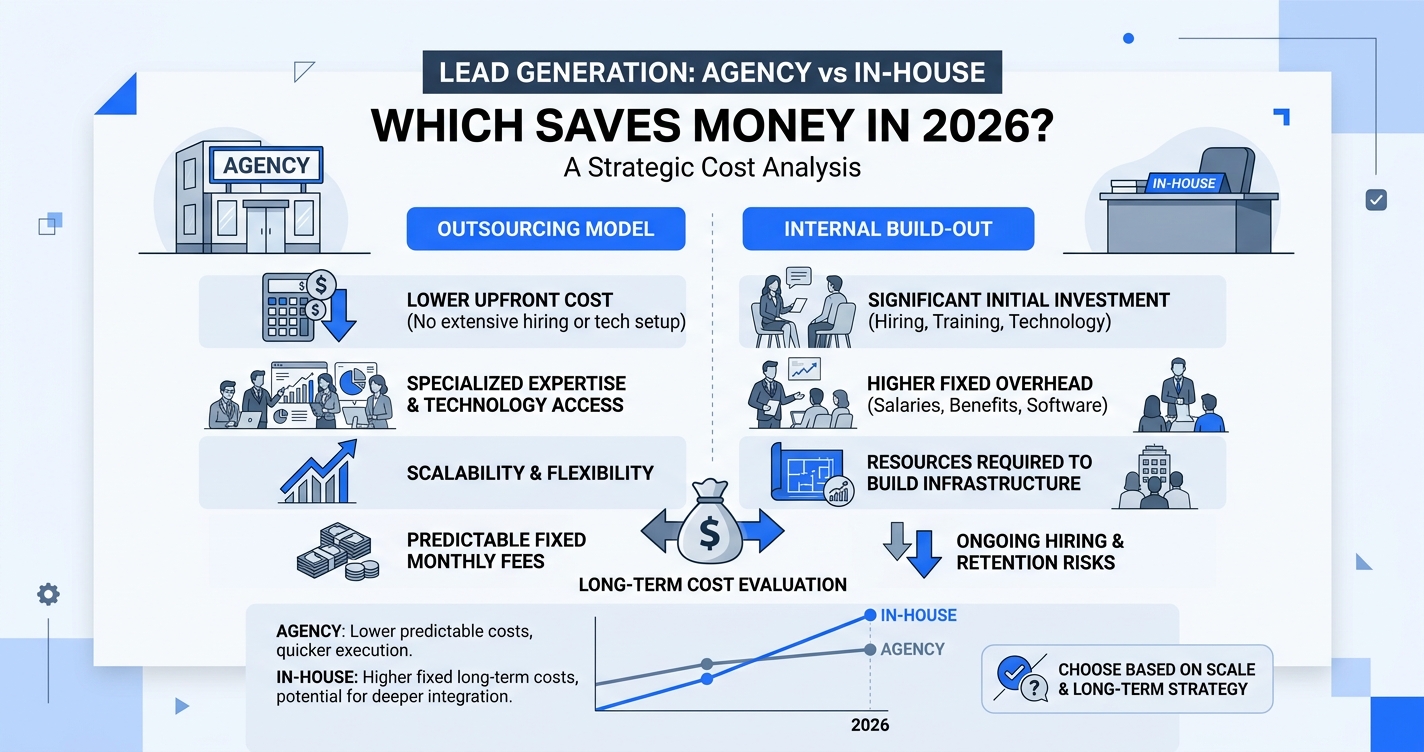
Lead Generation Agency vs In-House: Which Saves Money in 2026?
Cost comparison analysis that reveals hidden costs of in-house teams vs agency models, positioning pay-per-result as the only model that guarantees ROI regardless of team structure. Expert insights on lead generation agency from Seen By Many.
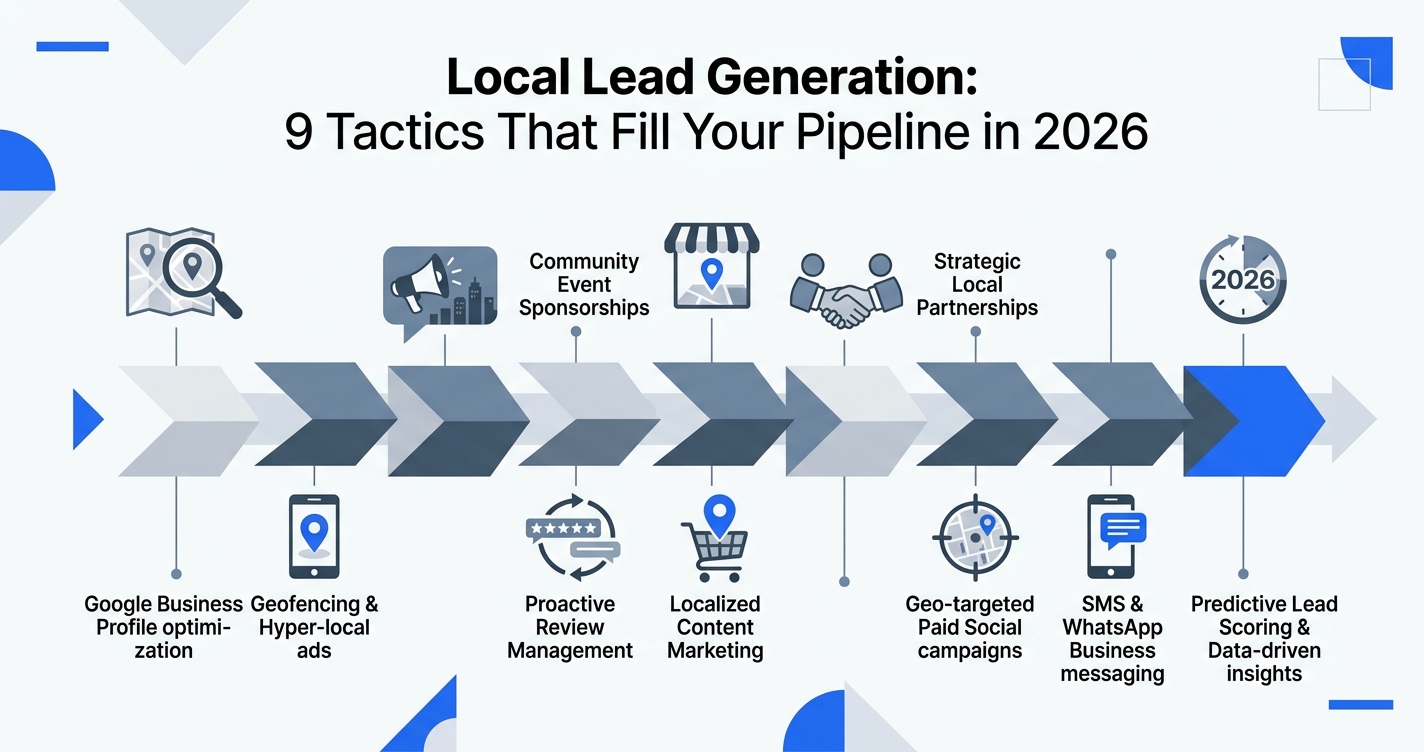
Local Lead Generation: 9 Tactics That Fill Your Pipeline in 2026
Hyper-local strategies with specific examples from local businesses we've helped, including cost-per-lead benchmarks by local service categories and geographic optimization techniques. Expert insights on local lead generation from Seen By Many.
Best Lead Generation Companies in 2026: Honest Reviews + Pricing
An honest, no-sugarcoating review of lead gen companies in 2026 — from someone who's worked with 200+ businesses and seen what actually works vs what's just good marketing.. Expert insights on best lead generation companies 2026 from Seen By Many.