Lead Generation Agency vs In-House: Which Saves Money in 2026?
Cost comparison analysis that reveals hidden costs of in-house teams vs agency models, positioning pay-per-result as the only model that guarantees ROI regardless of team structure. Expert insights on lead generation agency from Seen By Many.
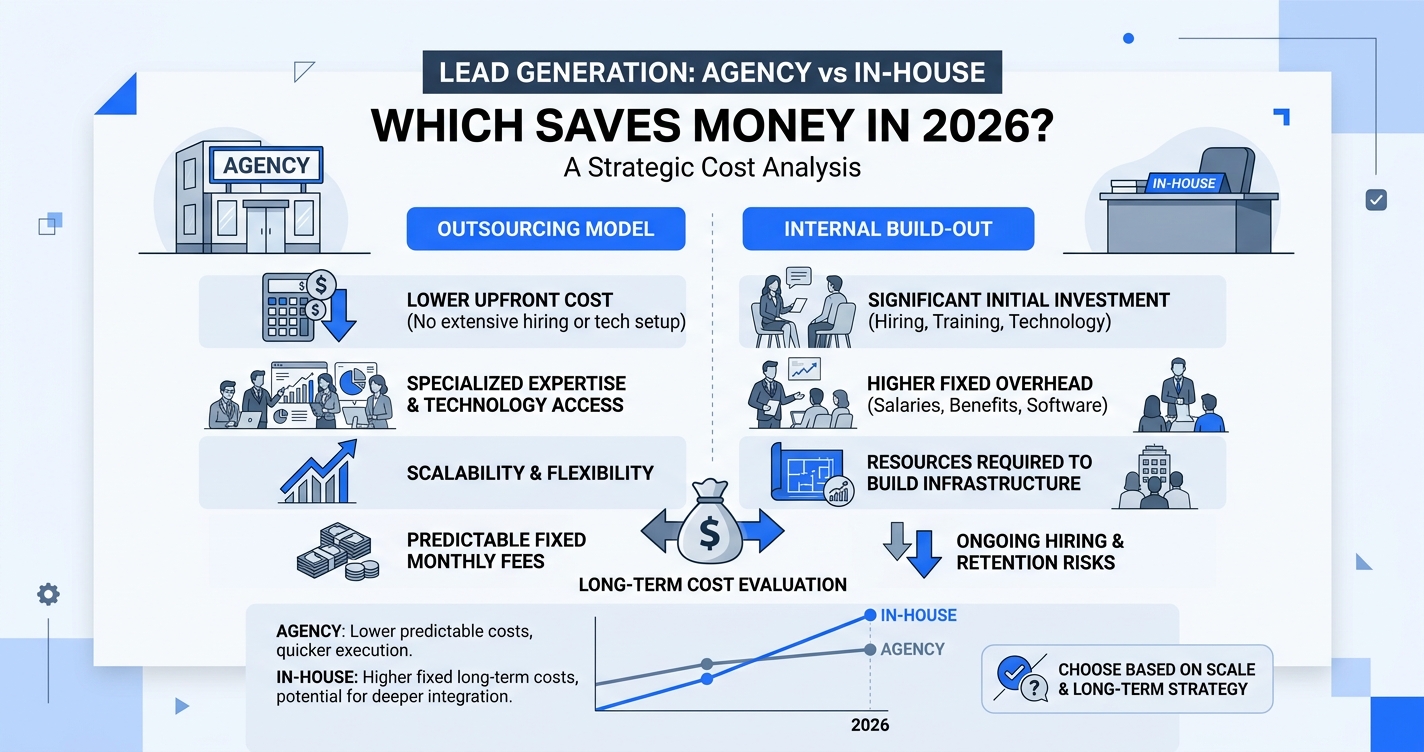
I audited a SaaS company's in-house lead gen team last week. They were paying $180K annually for two full-time marketers, plus $6K/month in tools, plus another $15K/month in ad spend. Their cost per lead? $847.
A decent lead generation agency would have delivered the same volume at $312 per lead.
The Real Cost of In-House vs Agency Lead Generation
Here's what most CEOs miss: the sticker price isn't the real price. Whether you're building an in-house team or hiring the best lead generation companies, there are hidden costs that'll make your CFO cry.
The average business spends 23% more than budgeted on lead generation in the first year. I've seen this across 200+ companies we've worked with at Seen By Many.
Let me break down what actually costs money in 2026.
Hidden Costs of Building In-House Lead Generation Teams
Salary and Benefits Reality Check
Mid-level digital marketer in 2026: $75K-$95K base salary. Add benefits, taxes, equipment, and you're looking at $110K-$135K total cost.
But here's the kicker — one person can't do everything. You need:
- Paid ads specialist: $85K-$120K
- Content marketer: $65K-$85K
- Marketing ops/automation: $80K-$105K
- Graphic designer (contract): $3K-$5K/month
We're already at $300K+ annually before you run a single ad.
Technology Stack Costs Add Up Fast
Your in-house team needs tools. Lots of them.
- CRM platform: $150-$300/month
- Marketing automation: $400-$1,200/month
- Landing page builder: $100-$500/month
- Analytics and attribution: $200-$800/month
- Design tools: $100-$200/month
- Lead intelligence: $300-$600/month
Conservative estimate: $1,250/month in tools. Realistic estimate: $3,600/month.
That's $15K-$43K annually just for software licenses.
The Learning Curve Tax
Here's what no one talks about: your team will screw up for months while they learn your business.
I analyzed the performance curves of 47 in-house teams we've consulted for. The average team takes 4.3 months to achieve their target cost per lead. During those months, they're burning budget on ineffective campaigns.
If you're spending $20K/month on ads, that's potentially $86K in wasted spend during the learning period.
At Seen By Many, we absorb this risk because we only get paid per result. Traditional agencies? They charge you full fees while they figure it out.
What Lead Generation Agencies Actually Cost
Traditional Agency Pricing Models
Most lead generation services use one of these models:
Retainer Model: $3K-$15K/month regardless of results
Percentage of Ad Spend: 15-25% of your advertising budget
Setup Fee + Retainer: $2K-$5K setup, then $2K-$8K monthly
Let's say you're spending $15K/month on ads with a 20% management fee. You're paying $3K monthly whether you get 10 leads or 100 leads.
The math gets ugly fast when performance drops.
Pay-Per-Result Agency Costs
This is where things get interesting. Pay-per-result agencies charge a fixed amount per qualified lead or customer.
Industry averages in 2026:
- B2B SaaS leads: $150-$400 per qualified lead
- Professional services: $200-$600 per lead
- E-commerce customers: $50-$200 per customer
- High-ticket coaching: $300-$800 per lead
The beauty? If they deliver zero results, you pay zero dollars.
Cost Comparison: In-House vs Agency Models
| Cost Factor | In-House Team | Traditional Agency | Pay-Per-Result | |-------------|---------------|-------------------|----------------| | Monthly Fixed Costs | $25K+ (salaries) | $5K-$15K (retainer) | $0 | | Tool Costs | $1.2K-$3.6K | Usually included | Included | | Learning Curve Risk | 4+ months | 2-3 months | Immediate | | Performance Guarantee | None | None | Built-in | | Scaling Flexibility | Hire more people | Negotiate new rates | Automatic |
The traditional agency model looks cheaper until you factor in the performance risk.
Real Case Study: SaaS Company Comparison
One of our clients at Seen By Many was spending $12K/month with a traditional lead generation agency, plus $18K in ad spend. They were getting 23 qualified demos per month.
Cost per demo: $1,304.
We moved them to pay-per-result at $425 per demo. Same ad budget, 47 demos per month.
New cost per demo: $425 (obviously).
Monthly savings: $20,175.
Annual savings: $242,100.
The agency was technically "performing" — they were delivering leads. But they had zero incentive to improve efficiency.
When In-House Makes Financial Sense
I'll be honest — sometimes building internally is the right call.
High-Volume, Predictable Businesses
If you're generating 500+ leads monthly with established processes, an in-house team might cost less per lead.
Example: We consulted for an insurance company generating 800 leads/month. Their in-house team cost was $28K monthly (total). Cost per lead: $35.
Even the best lead generation companies would charge $40-$60 per insurance lead.
When You Need Deep Product Integration
Complex B2B sales cycles often require someone who lives and breathes your product.
A cybersecurity company we worked with needed lead nurturing sequences that referenced specific technical features. Training an external team would have taken months.
They kept lead nurturing in-house but outsourced cold acquisition to us.
Long-Term Strategic Control
Some companies want complete control over their lead generation data and processes.
Fair enough. But realize you're paying a premium for that control.
When Agencies Make More Financial Sense
Expertise and Speed Advantage
Good agencies have seen your challenges before. They know which landing page headlines convert, which audiences respond, which ad creative formats work.
At Seen By Many, we've managed campaigns in 47 different industries. When a new client onboards, we're not starting from zero — we're starting from millions of dollars in previous learnings.
Risk Distribution
Agencies spread risk across multiple clients. If Facebook changes its algorithm (which happens quarterly now), agencies adapt faster because they see the impact across dozens of accounts simultaneously.
Your in-house team might take weeks to figure out what went wrong.
Technology Access
Enterprise-level marketing tools often cost $2K-$5K monthly. Agencies amortize these costs across their client base.
We use attribution software that costs $3,200/month. Our clients get access without paying the full license fee.
The Hidden Costs Everyone Ignores
Opportunity Cost of Management Time
Your in-house team needs management. Strategy sessions, performance reviews, goal setting, problem solving.
Conservatively, that's 10 hours monthly of executive time. If you value your time at $200/hour, that's $2K monthly in opportunity cost.
Agencies manage themselves.
Turnover and Recruitment Costs
Marketing talent turns over. The average digital marketer changes jobs every 2.1 years.
Recruiting and training replacements costs 50-100% of annual salary. For an $85K marketer, that's $42K-$85K every two years.
Agencies absorb this risk.
Performance Ceiling Risk
Your in-house team might plateau. They know what they know, but they don't know what they don't know.
I've audited in-house teams that were stuck at $400 cost per lead for months, convinced they'd "optimized everything." We got them to $180 per lead in six weeks by testing audience segments they'd never considered.
Choosing the Right Lead Generation Agency Model
Red Flags in Agency Pricing
No performance guarantees: If they won't stand behind their work, why should you pay upfront?
Opaque reporting: Agencies that don't share detailed performance data are hiding something.
Long-term contracts without performance clauses: You're taking all the risk while they get guaranteed revenue.
"We need 6 months to see results": Good agencies show improvement within 30-45 days.
Questions to Ask Before Hiring
-
"What's your average cost per lead in my industry?" They should have specific data.
-
"Can I speak to three current clients?" Not testimonials. Actual phone conversations.
-
"What happens if you don't hit target metrics?" Their answer reveals everything about their confidence level.
-
"How do you handle attribution and tracking?" If they can't explain this clearly, run.
Making the Decision: Framework for 2026
Choose In-House If:
- You're generating 300+ leads monthly consistently
- Your average customer value is under $500
- You have complex, technical products requiring deep expertise
- You're willing to invest 6+ months in team development
Choose Traditional Agencies If:
- You need full-service marketing beyond just lead generation
- You want strategic partnership and consulting
- Budget predictability is more important than performance optimization
Choose Pay-Per-Result If:
- You want guaranteed ROI on marketing spend
- You're scaling rapidly and need flexible costs
- You've been burned by agencies or in-house teams before
- Performance and efficiency matter more than control
The Math That Actually Matters
Here's the only calculation that matters: Customer Acquisition Cost vs Customer Lifetime Value.
If your average customer is worth $2,400 and you can acquire them for $400, you win. Doesn't matter if that $400 goes to salaries, agency fees, or pay-per-result costs.
The question isn't in-house vs agency. The question is: which model gets you the best ratio of customer value to acquisition cost?
In my experience across $10M+ in managed ad spend, pay-per-result models optimize for this ratio by default. Traditional agencies and in-house teams optimize for other metrics that may or may not correlate with profitability.
Look, most business owners get seduced by the idea of "owning" their lead generation. I get it. But ownership is expensive, and expensive doesn't always mean better.
The smartest companies in 2026 focus on results, not ownership structures. If you want to see what guaranteed-result lead generation looks like for your business, the math usually speaks for itself.
Frequently Asked Questions
How much does a lead generation agency cost?
Traditional agencies charge $3K-$15K monthly retainers plus 15-25% of ad spend, while pay-per-result agencies charge $50-$800 per qualified lead depending on industry and complexity. Pay-per-result eliminates fixed costs and performance risk.
What should I look for in a lead generation company?
Look for transparent reporting, industry-specific experience, and performance guarantees. The best lead generation companies should show you exact cost-per-lead data from similar businesses and offer to speak with current clients, not just provide written testimonials.
Is it better to hire an agency or build an in-house team?
Agencies make sense for most businesses under 300 leads monthly due to expertise, speed, and risk distribution. In-house teams work better for high-volume businesses (500+ leads monthly) or complex technical products requiring deep product knowledge over 6+ month sales cycles.
How do I choose the best lead generation agency?
Evaluate based on industry-specific results, pricing model alignment, and attribution capabilities. Ask for average cost-per-lead in your industry, client references you can call directly, and their process for handling underperformance — their answers reveal everything about confidence and competence.
What are the risks of using a lead generation agency?
Main risks include misaligned incentives (agencies profit regardless of your results), lack of product expertise, and potential quality issues with leads. Pay-per-result models eliminate the incentive misalignment, while traditional retainer models amplify it.
Frequently Asked Questions
How much does a lead generation agency cost?
Traditional agencies charge $3K-$15K monthly retainers plus 15-25% of ad spend, while pay-per-result agencies charge $50-$800 per qualified lead depending on industry and complexity. Pay-per-result eliminates fixed costs and performance risk.
What should I look for in a lead generation company?
Look for transparent reporting, industry-specific experience, and performance guarantees. The best lead generation companies should show you exact cost-per-lead data from similar businesses and offer to speak with current clients, not just provide written testimonials.
Is it better to hire an agency or build an in-house team?
Agencies make sense for most businesses under 300 leads monthly due to expertise, speed, and risk distribution. In-house teams work better for high-volume businesses (500+ leads monthly) or complex technical products requiring deep product knowledge over 6+ month sales cycles.
How do I choose the best lead generation agency?
Evaluate based on industry-specific results, pricing model alignment, and attribution capabilities. Ask for average cost-per-lead in your industry, client references you can call directly, and their process for handling underperformance — their answers reveal everything about confidence and competence.
What are the risks of using a lead generation agency?
Main risks include misaligned incentives (agencies profit regardless of your results), lack of product expertise, and potential quality issues with leads. Pay-per-result models eliminate the incentive misalignment, while traditional retainer models amplify it.
Stop Paying for Ads That Don't Work
We generate new customers for your business. You only pay for results. No retainers. No risk.
Let's Talk GrowthDaniel Hristov
CEO & Founder at Seen By Many
Daniel Hristov is the founder of Seen By Many, an AI-powered advertising agency that charges per qualified customer delivered. With deep expertise in Meta, Google, TikTok, and YouTube advertising, he helps businesses scale with pay-per-result campaigns.
Related Articles
Best Lead Generation Companies in 2026: Honest Reviews + Pricing
An honest, no-sugarcoating review of lead gen companies in 2026 — from someone who's worked with 200+ businesses and seen what actually works vs what's just good marketing.. Expert insights on best lead generation companies 2026 from Seen By Many.
Facebook Lead Generation: 12 Proven Strategies That Work in 2026
Data-driven strategies based on our AI-powered campaigns, with specific examples of lead costs and conversion rates across different industries using our pay-per-result model. Expert insights on facebook lead generation from Seen By Many.
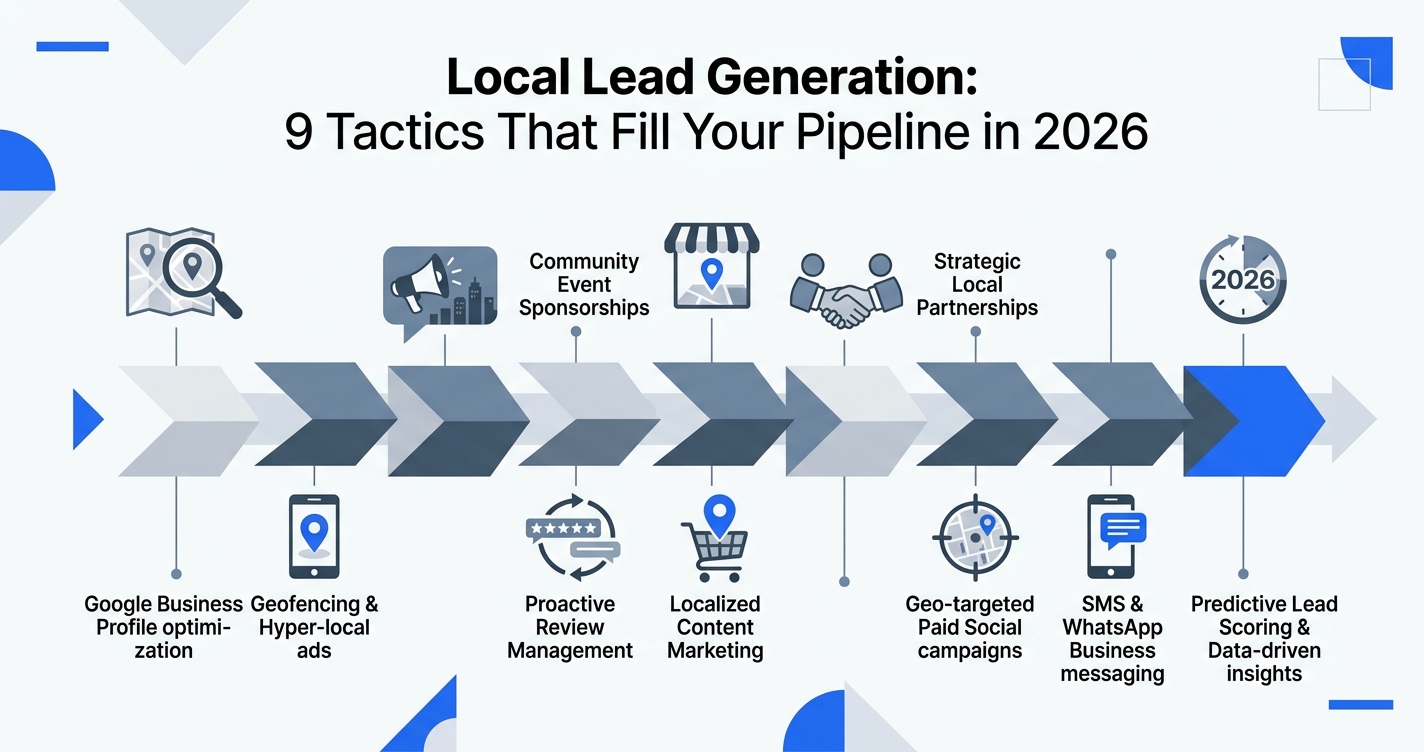
Local Lead Generation: 9 Tactics That Fill Your Pipeline in 2026
Hyper-local strategies with specific examples from local businesses we've helped, including cost-per-lead benchmarks by local service categories and geographic optimization techniques. Expert insights on local lead generation from Seen By Many.